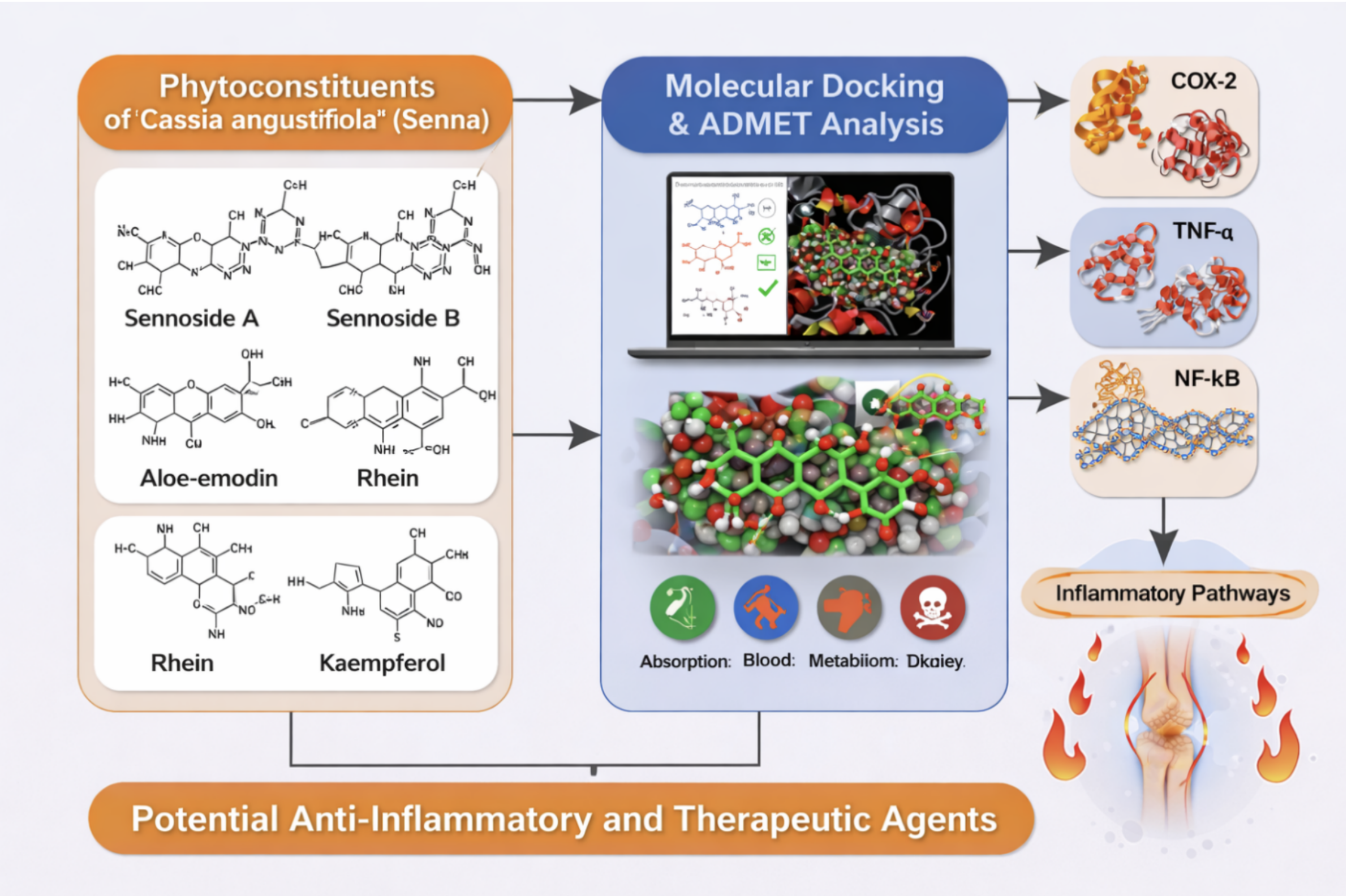
Chronic inflammatory conditions remain a major global therapeutic challenge, often limited by the adverse gastrointestinal and cardiovascular safety profiles of conventional non-steroidal anti-inflammatory drugs (NSAIDs). While plants from the genus Cassia have been used in traditional medicine for their anti-inflammatory properties, the distinct structural and pharmacokinetic contributions of their glycoside versus aglycone phytoconstituents have not been fully elucidated at the molecular level. The current study aims to bridge this knowledge gap by evaluating the binding configurations and drug-likeness profiles of five prominent Cassia phytoconstituents, Sennoside A, Sennoside B, Rhein, Aloe-emodin and Kaempferol-3-O-gentiobioside against three key inflammatory targets such as cyclooxygenase-2 (COX-2), nuclear factor kappa B (NF-κB) and tumor necrosis factor-alpha (TNF-α). Using an integrated computational approach combining molecular docking and in silico ADMET profiling, we uncovered a clear dual-mechanism structural model. Molecular docking revealed that glycosides (Sennosides A and B) exhibit strong binding affinity for the COX-2 channel entrance (up to -10.6 kcal/mol) through steric occlusion and hydrogen bonding with Cys47, whereas aglycones penetrate deep into the hydrophobic cavity to engage catalytic residues such as Tyr385. Across NF-κB and TNF-α, all evaluated compounds successfully attached conserved regulatory zones, including the Ser363-proximal region of NF-κB and the trimer-interface "Tyrosine Cage" of TNFα. ADMET evaluations highlighted that, sennosides displayed characteristics of colon-restricted prodrugs requiring microbiota-mediated activation, whereas aglycones such as Rhein demonstrated favourable systemic bioavailability and a clean cytochrome P450 inhibition profile. This dual-pharmacokinetic model categorises Cassia constituents into locally active glycoside prodrugs and systemically active aglycones, providing a strong foundation for future in vitro and in vivo validation.
Research ArticleFREE
Computational Evaluation of Cassia Phytoconstituents as Anti-Inflammatory Agents through Integrated Molecular Docking and ADMET Profiling
Submitted June 1, 2026
Published August 12, 2026
Pharmacology & drug discovery
Unig Science
Archive Details:
Vol. 2, Issue 2, July to December 2026
Authors (4)
Pramely R
Co-authorPhD
Leon Stephan Raj
 Corresponding Author 1
PhD
Sathyananth M
First AuthorMSc
Jenifer C
Co-authorMSc
Abstract
Keywords
Cassiamolecular dockinganti-inflammatorySennoside ARheinCOX-2NF-κBTNF-αADMETdrug repurposing