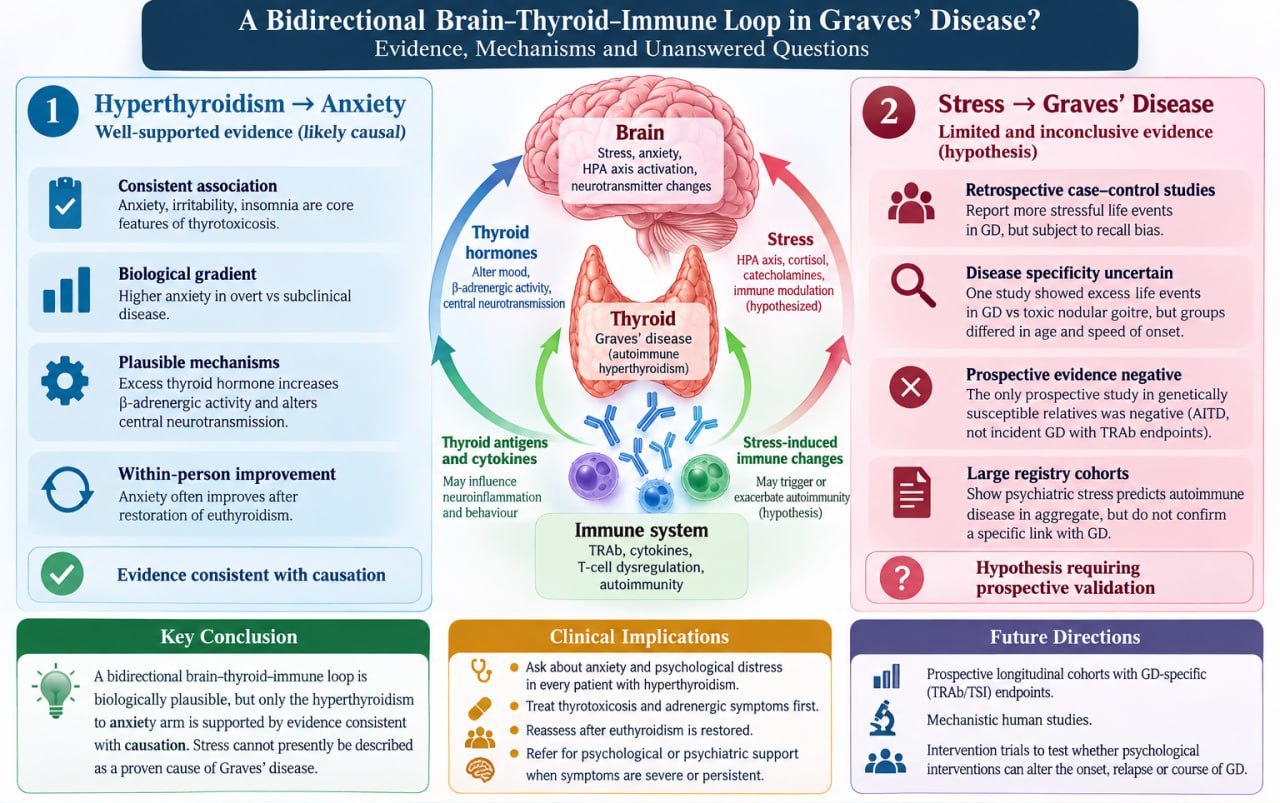
Graves’ disease (GD), the commonest cause of hyperthyroidism, is frequently associated with anxiety, irritability and insomnia. Stressful life events have long been proposed as triggers of GD, raising the possibility of a bidirectional brain–thyroid–immune loop. This narrative review critically evaluates evidence for both directions: hyperthyroidism causing anxiety and psychological stress contributing to autoimmune hyperthyroidism. PubMed/MEDLINE was searched to September 2026 for human studies addressing GD, hyperthyroidism, anxiety, stress and relevant neuroendocrine and immune mechanisms. Evidence is markedly asymmetric. The hyperthyroidism-to-anxiety pathway is supported by consistent associations, a biological gradient, plausible β-adrenergic and central thyroid-hormone mechanisms, and improvement in psychological symptoms after restoration of euthyroidism. In contrast, evidence linking stress to GD derives predominantly from retrospective case–control studies vulnerable to recall and reverse-causation bias. Evidence comparing GD with toxic nodular goitre suggests possible specificity to autoimmunity but is limited by confounding. The only prospective study was negative but examined broader autoimmune thyroid disease rather than incident TRAb/TSI-defined GD. Registry studies associate stress-related disorders with autoimmune disease generally but cannot establish a GD-specific effect. A bidirectional brain–thyroid–immune loop is therefore biologically plausible, but current evidence supports causation primarily from hyperthyroidism to anxiety. Stress cannot presently be considered a proven cause of GD. Clinicians should assess psychological distress, treat thyrotoxicosis and adrenergic symptoms, and reassess patients after euthyroidism, as anxiety and mental fatigue may persist. Prospective longitudinal studies using GD-specific TRAb/TSI endpoints are needed to clarify whether stress influences GD onset or progression.
Review ArticleFREE
A Critical Narrative Review Emphasizing Graves’ Disease to Determine If a Bidirectional Brain–Thyroid–Immune Loop Exists in Stress, Anxiety and Hyperthyroidism
Submitted September 15, 2026
Published September 21, 2026
Medicine and Health Sciences
Unig Science
Archive Details:
Vol. 2, Issue 2, July to December 2026
Authors (8)
Saniya Siddiqua
 First Author
MBBS
Iftekharul Haque
Corresponding Author 1MBBS
Shreya Lucas
Corresponding Author 2MBBS
Saara Zameer
Co-authorMBBS
Namrah Zameer
Co-authorMBBS
Amrita Nayak
Co-authorMBBS
Christy Joy
Co-authorMBBS
Tarannum Naaz
Co-authorMBBS
Abstract
Keywords
Graves’ diseasehyperthyroidismanxietypsychological stressHPA axisthyroid autoimmunityTSH receptor antibodypsychoneuroimmunology.