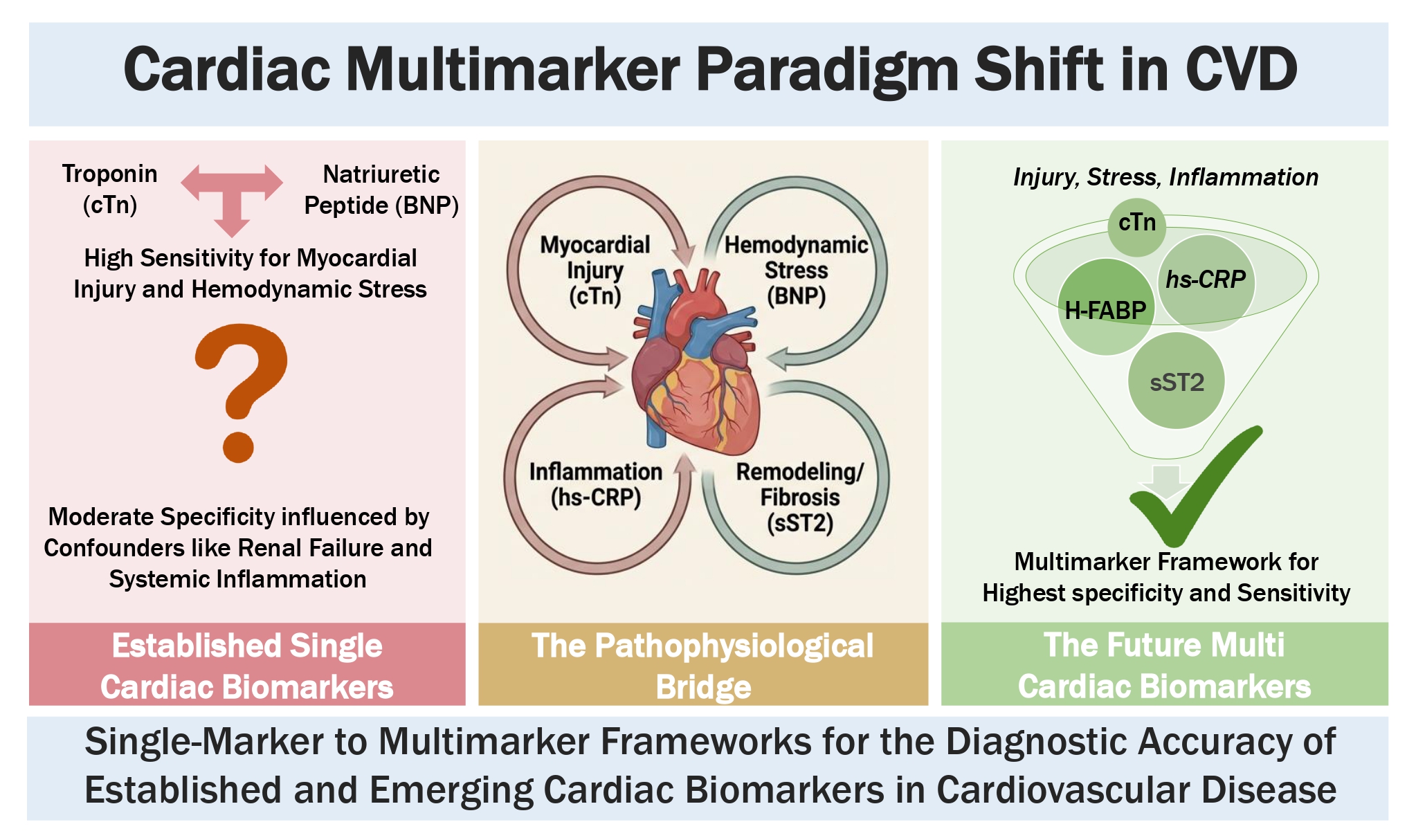
Cardiovascular disorders (CVDs), especially heart failure (HF) and stable coronary artery disease (CAD) are primary global factors to high mortality and morbidity. Early diagnosis using cardiac biomarkers is essential for therapeutic management, but the transition from individual CVD markers to integrated diagnostic multimarkers remains complex. This narrative review analyse the diagnostic efficacy, clinical significance and various limitations of both recognised and novel CVD biomarkers. This systematic literature search was performed using PubMed, Scopus and Google Scholar. Research studies were chosen based on their reporting of sensitivity and specificity for detecting cardiovascular diseases with a preference for systematic reviews and extensive multicenter cohorts. Qualitative analysis was conducted on data from several significant research including the BACH, BIOMArCS, and MESA trials. High-sensitivity cardiac troponins (cTn) and natriuretic peptides (BNP/NT-proBNP) are still the best tests for heart damage and stress on the blood flow of heart. They have a high sensitivity (up to 0.94). But their specificity is generally only moderate (0.70–0.79) because of things like kidney problems and systemic inflammation that get in the way. New biomarkers including Heart-Type Fatty Acid-Binding Protein (H-FABP) and soluble ST2 (sST2) offer promise for earlier identification. However, they haven't been tested on a wide scale yet. Multimarker techniques that combine markers of injury, stress and inflammation (like hs-CRP) are consistently better than single-marker tactics. They have sensitivities more than 0.95 and specificities ~ 0.85. Although cTn and natriuretic peptides are essential in clinical practice, their individual accuracy is constrained by moderate specificity. A change in thinking toward multimarker frameworks leads to better diagnostic of CVD and prognostic results. Future research should concentrate on standardised, multicenter validation of these integrated CVD markers to enhance their efficacy into early diagnosis of CVD.
UnigScience2 (2026) : 4
Review ArticleFREE
Evolution from Single-Marker to Multimarker Frameworks for the Diagnostic Accuracy and Clinical Utility of Established and Emerging Cardiac Biomarkers in Cardiovascular Disease
Submitted March 20, 2026
Published March 25, 2026
Medicine and Health Sciences
Unig Science
Archive Details:
Vol. 2, March 2026
Article ID:
UNS4
Authors (7)
Kalash Dwivedi
 Corresponding Author 1
MD
Jainil Sejpal Sejpal
Co-authorMD
Syed Meyar Hussain
Co-authorMD
Yazdani Qureshi
Co-authorMD
Saniya Siddiqua
Co-authorMD
Shorey Steffi Anthony
Co-authorMD
Syeda Naazneen Sultan
Co-authorMD
Abstract
Keywords
Cardiac BiomarkersDiagnostic AccuracyMultimarker ApproachHigh-Sensitivity TroponinNatriuretic PeptidesHeart FailureStable Coronary Artery DiseaseH-FABP