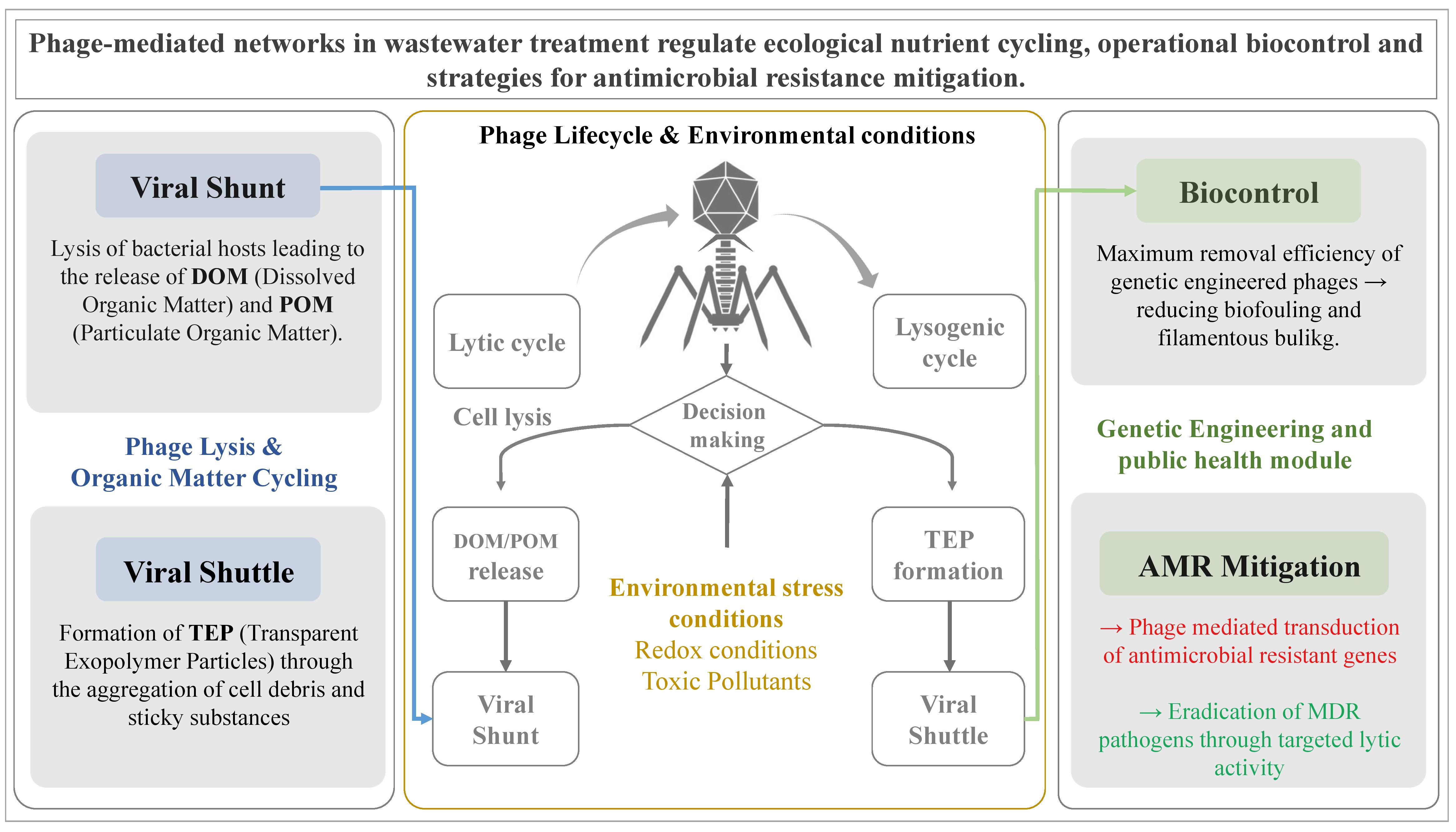
Wastewater treatment plants (WWTPs) are important environmental barriers and places to recover resources, but bacteriophages, which are microscopic dark matter, are still not well understood as a regulator of these biological systems. Phages are more common than bacteria and control the structure of microbial communities through lytic, lysogenic, and chronic life cycles that are affected by factors in the environment. In addition to predation, phages alter ecosystem biogeochemistry through auxiliary metabolic genes, improving nutrient cycling and aiding host adaptation to toxic stresses and pollutants. This review looks at how phages affect both the effectiveness of treatment and public health. Phages move organic matter through the viral shunt and viral shuttle which speeds up biomass growth and methanogenesis while also making biofilms more stable. Phages provide long-lasting biocontrol for filamentous bulking and biofouling in activated sludge and membrane bioreactors. Engineered variants can remove up to maximum of biofilm. Moreover, phages serve as exceptionally accurate biosensors for pathogen identification. WWTPs are known to be major places where antimicrobial resistance (AMR) spreads. Phages can help antibiotic resistance genes (ARGs) move from one bacterium to another, but they can also be a strong alternative to chemical disinfection. Recent research indicates that lytic phages and tailored cocktails can efficiently eliminate multidrug-resistant (MDR) pathogens such as Escherichia coli and Klebsiella pneumoniae without generating detrimental byproducts. Integrating phage surveillance and biocontrol into standard treatment protocols is essential for managing microbial complexity and mitigating AMR hazards. To improve the performance of WWTPs, future research needs to bring together ecological models like Kill-the-Winner with the complex viral-microbial networks that are naturally present in engineering environments.
Review ArticleFREE
Bacteriophage Dark Matter Dynamics in Wastewater Treatment Systems and Strategies for Antimicrobial Resistance Mitigation
Submitted March 5, 2026
Published March 25, 2026
Industrial & environmental microbiology
Unig Science
Archive Details:
Vol. 2, March 2026
Authors (1)
Williams Jothy
 First Author
PhD
Abstract
Keywords
Wastewater treatment plantsAntimicrobial resistanceViral shuntBiofilm controlMicroscopic dark matterEcological dynamics